
Riyadh Action Agenda: Welcoming initiatives to build on the momentum
Photo by: Juan Valle - iStock
Healthy land and soils are vital for people, the climate, and biodiversity. They are the foundation of human and ecosystem livelihoods and subsistence. Yet, nearly half of the world's land is degrading, risking humanity’s chances of overcoming the climate and biodiversity crises. But it’s not too late…
Let’s run a quick refresher
Last December, UNCCD COP16: the largest and most diverse conference of its kind to date, took place in Riyadh, Saudi Arabia. It brought together tens of thousands of participants – around 3,500 of them from civil society – and featured more than 600 events as part of the first Action Agenda to involve non-state actors in the work of the Convention. It was a landmark moment anchored in a simple but profound truth: to protect our future, we must save our land.
The numbers don't lie.
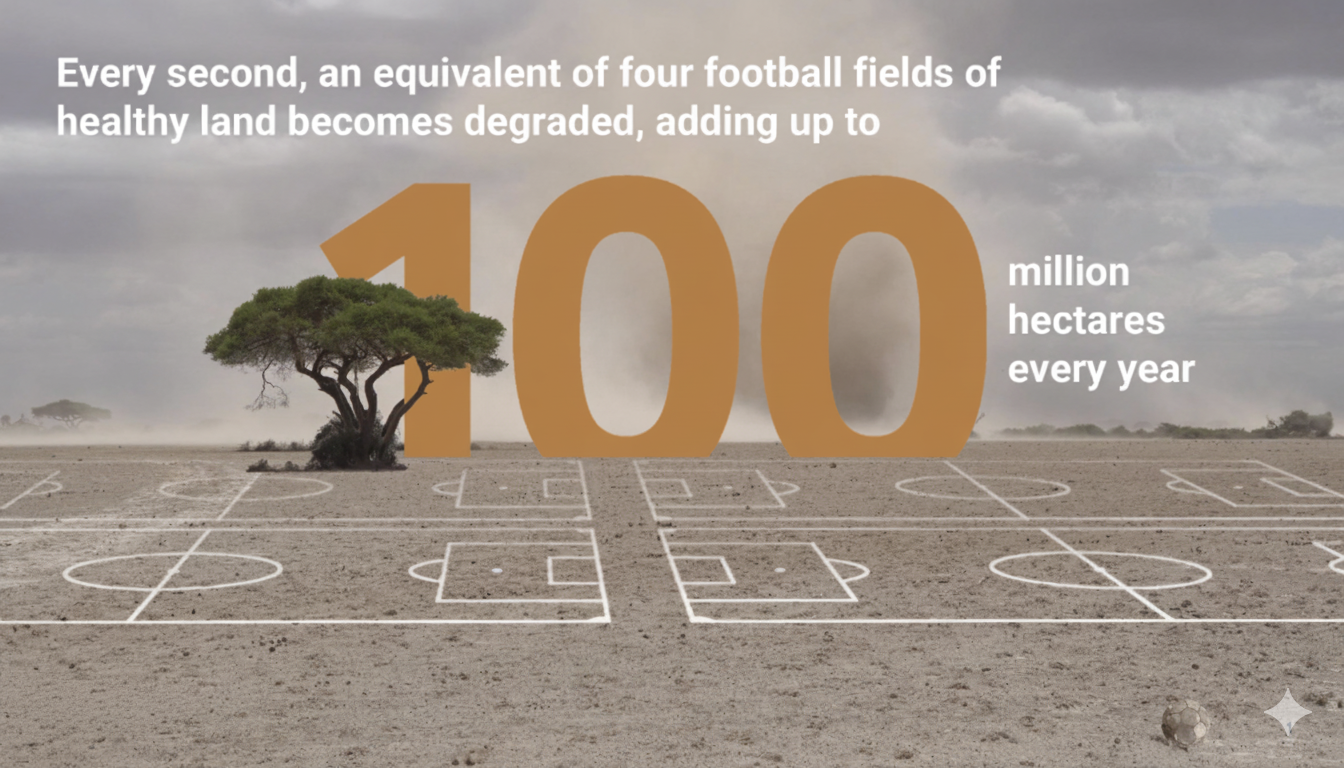
Every second , an equivalent of four football fields of healthy land becomes degraded, adding up to 100 million hectares every year. Up to 40% of the planet’s land is degraded – spanning the world’s drylands, grasslands, croplands, wetlands, rivers, and forests.
And droughts – primary drivers of land degradation – now account for 15% of all natural disasters.
Following current trends, by 2050, 90% of the world’s landscapes could be degraded, losing their quality, productivity, and ability to support life – and impacting over 75% of the global population.
So what does this mean?
Affecting around one third of agricultural land, human-induced land degradation directly jeopardizes the livelihoods of around 1.5 billion people, costing US$300 billion in agriculture production every year, and significantly undermining food and nutrition security.
The global economy is taking a big hit, with ecosystem services equivalent to 10% of the annual global gross product actively affected by land degradation – and with more than 50% of the global GDP being moderately to highly dependent on natural capital, the hit could be worryingly higher.
And human displacement is on the rise. By 2030, 700 million people could be displaced due to drought, and by 2050, the number of people living in water-stressed transboundary basins could double, increasing the risk of conflict.
But with collective coordinated action, we can still save our land and protect our future.
There’s no denying. The situation is critical, and the solutions needed are urgent and must be delivered at scale.
Launched by the UNCCD COP16 Presidency, the Kingdom of Saudi Arabia, last December in Riyadh, the Riyadh Action Agenda is a pioneering platform mobilizing coordinated action between states and non-state actors to restore 1.5 billion hectares of degraded land by 2030. It is underpinned by three overarching goals that amplify global commitments:
Conserve and restore 1.5 billion ha of degraded land, including 250 million ha of degraded agricultural land.
Boost drought and water resilience, protecting 30% of lands and inland waters.
Mobilize US$2.1 trillion in global investments towards these goals.
The Riyadh Action Agenda recognizes that scaling and speeding up practical land solutions that are socially, environmentally and economically beneficial, needs us all – from businesses to farmers, sub-national governments to investors, and researchers to Indigenous Peoples and local communities – supporting state commitments and driving further ambition.
So, while remaining distinct from the UNCCD global negotiations, the Riyadh Action Agenda strengthens partnerships to advance progress on global land goals, restoring our planet’s health, securing livelihoods, and helping deliver a prosperous future for all.
A global effort with widespread support
The Riyadh Action Agenda was built through several rounds of consultation, including a vast network of 400+ subject experts, working groups across different thematic areas, more than 500 bilateral meetings, and six multi-stakeholder dialogues which gathered more than 300+ non-state actors, during UNCCD COP16, in Riyadh.
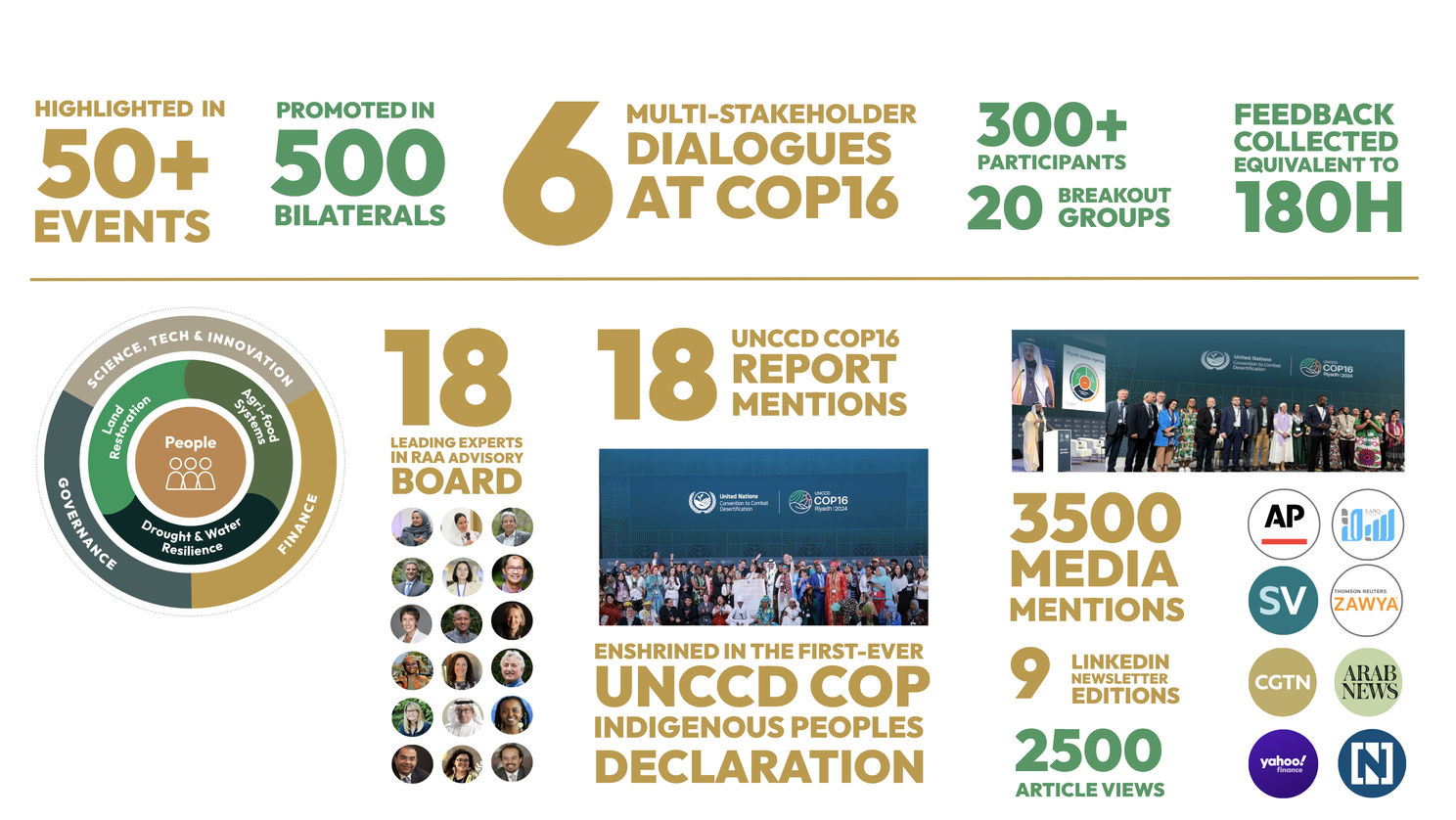
Riyadh Action Agenda launch in figures (September 2026)
Building on the momentum: your unique role
Since UNCCD COP16, we have focused on maintaining the diverse and inclusive energy witnessed in Riyadh, by incorporating the equivalent of more than 180 hours of feedback into the Riyadh Action Agenda text.
With a developed anchoring text, the Riyadh Action Agenda is now ready to demonstrate momentum on land conservation and restoration and drought resilience. The following components will underpin the Action Agenda’s implementation:
Mobilizing initiatives and partners: continuing to build a strong partner database to facilitate alignment and engagement.
Developing Breakthrough Targets: this set of sub-goals and granular targets will support the Riyadh Action Agenda community acting as a guide for implementation.
Building a framework for joint monitoring and sharing of progress: celebrating achievements by the Riyadh Action Agenda initiatives and encouraging a positive loop of ambition.
The Riyadh Agenda has officially opened the process for aligned initiatives to be formally included under its umbrella.
As a critical actor in safeguarding and stewarding the world’s landscapes, you can join hundreds of leading initiatives and organizations in showcasing momentum for and raising ambition on global land goals.
Together, we can:
Contribute to the generation of an estimated annual economic flow of US$1.8 trillion from increased productivity and avoided damages.
Support the livelihoods of 1.5 billion people working and trapped on degrading agricultural land.
Avert the displacement of 700M people due to drought – and prevent water shortages for three quarters of humanity.
Getting involved:
By supporting the Riyadh Action Agenda, you are joining a community of leading initiatives and organizations united under a pioneering global platform.
Joining is simple: Express your interest to officially support the Riyadh Action Agenda, sharing your land restoration and conservation, drought and water resilience, and/or financial mobilization commitments and progress via the official online form.
Together, we can save our land and protect our future.
*All the facts and data referenced in this article has been extracted from the Riyadh Action Agenda text – an extensive research effort quoting globally recognized academic studies and reports by international organizations, consulting firms and NGOs among others. Access the Riyadh Action Agenda text here.
Enjoyed this post? Subscribe to the newsletter!
This blog post was authored by the RAA Delivery team (Ambition Loop) as part of the Lay of the Land LinkedIn newsletter. Liked it?
